KIWAI AB - PLANT
Actinidia arguta
 Récolte
Caractéristiques de la plante
Cycle de vie : perennial
Conseils de culture
Description
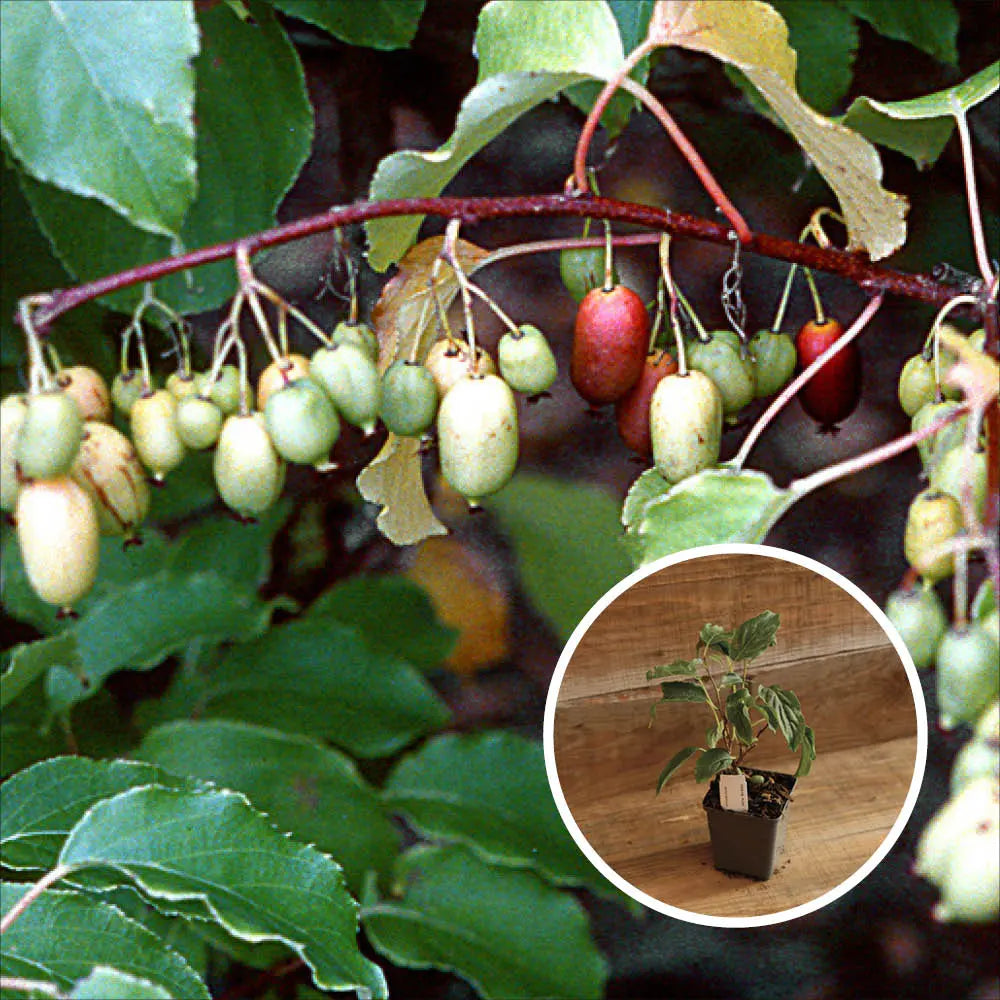
The 'Issai' Kiwifruit is a self-fertile variety that does not require cross-pollination. Its small flowers, much smaller than those of the kiwi, produce smooth, green-colored fruits. These fruits ripen slowly on the tree between October and November and are picked when they peel easily. They can be eaten without peeling and offer a sweet, fragrant flavor.
This variety is slightly more vigorous than kiwi, but its growing requirements are similar. Sturdy training is required to support the plant and its production.
Native to Northern Asia, kiwis are quite hardy and require less care than kiwis. They do not tolerate poorly drained, heavy soils, or stagnant water in the spring. They prefer rich, airy, and fresh soils.
Even when slightly wilted, the fruits retain their flavor and can be used in juices, jams, jellies, or compotes. They are rich in sugar and vitamin C.
Kiwi harvest :
- Kiwi fruit is generally harvested in late summer or early fall (September to October depending on growing conditions). The fruit is ready to be picked when its skin becomes slightly softer to the touch and its color is uniform.
- The fruits can be harvested before they are fully ripe , as they ripen well after picking, allowing them to be stored for a little longer.
Le Kiwaï nécessite-t-il une pollinisation croisée ?
Non, cette variété est autofertile, mais un autre sujet à proximité peut améliorer légèrement la production.
Peut-on cultiver le Kiwaï en pot ?
Oui, à condition d’utiliser un grand contenant et un palissage solide pour soutenir la plante et sa production.
Comment conserver les fruits après récolte ?
Ils se conservent quelques semaines au réfrigérateur et plusieurs mois s’ils sont stockés dans un endroit frais et sec. Ils peuvent également être séchés ou transformés en préparations culinaires.
Le Kiwaï est-il rustique ?
Oui, il résiste à des températures basses et s’adapte bien aux climats tempérés, tant qu’il est planté dans un sol bien drainé.