

SPANISH CAVAILLON MELON WITH PINK FLESH AB
Cucumis melo
 Récolte
Conseils de semis
Cycle de vie : annual
Durée de levée : 7 to 10 days
Température de levée : 25 to 30°C
Technique de semis : online
Profondeur de semis : equal to seed size, point down
Contenants de semis : in a bucket / in open ground
Conseils de culture
Description
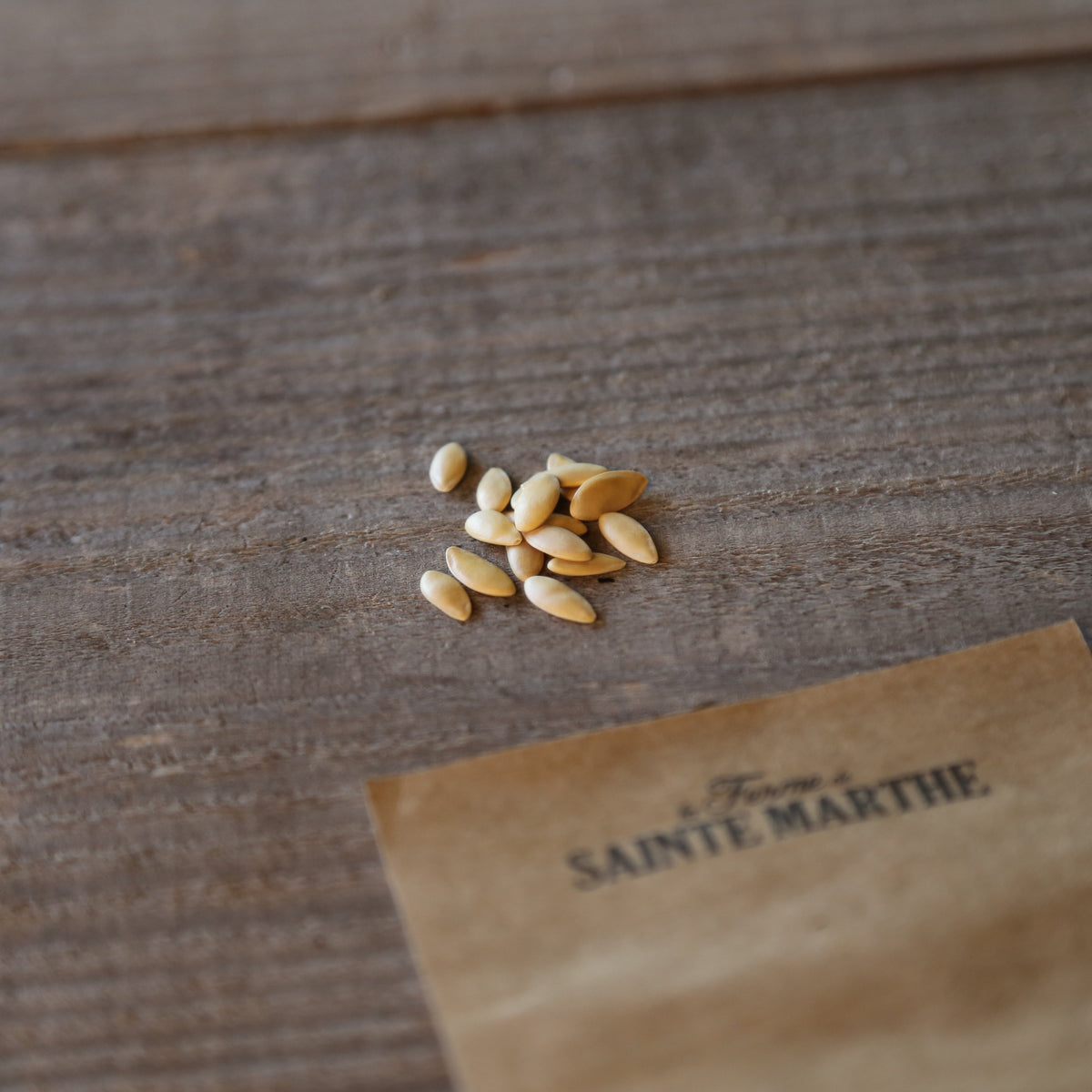
The Spanish Cavaillon Melon is an old French variety, producing beautiful elongated, embroidered fruits, weighing around 1.5 to 2 kg . Their flesh is salmon-colored, juicy, fragrant and sweet. It is later than classic Charentais melons, but keeps well after harvest.
How to successfully sow melons
Sowing melons in pots
Melons need a lot of heat (between 24 and 35°C ) and light to germinate. The temperature during the day should therefore be within this range and not drop below 15°C at night. It is therefore best to sow your melon seeds in a warm frame or heated greenhouse in March/April , and replant them in the garden after mid-May, once the risk of frost has passed.
Sow 2 or 3 seeds (point down) per pot filled with fine seed compost at a depth of 1 cm. Water regularly to keep the compost moist, but not soggy, using a sprayer. Place next to a window or in full light. As soon as the seedlings appear, their need for light becomes crucial. Make sure to place them in a very sunny location. Remove the weakest plants and keep only the most vigorous ones.
Melon sowing in place
Another solution, more commonly used by people living in the south of France or in a Mediterranean climate, is to sow directly in the ground.
Space the seedlings 80 cm to 1 m apart between each future melon plant. Place 2 to 3 seeds per pocket ( 1.5 cm deep ) and cover with a mixture of sifted garden soil and mature compost. Protect the seedlings with a cloche or a frame at the beginning of the growing season. Keep only the best-looking plant.
Melon planting
Depending on the region, you can plant young melon plants in the garden between April and mid-June . We recommend keeping a plastic tunnel at the beginning of the growing season to provide more heat. If you do not live in the south, it is recommended to use a heated greenhouse for growing melons and watermelons.
Make sure to maintain a spacing of 80 cm to 1 m between each plant. Melons prefer a warm, sunny location, and rich, deep potash soil. Feel free to loosen the soil a little before planting and add a little compost.
Association with the vegetable garden
In the vegetable garden, melon will get along well with most vegetables, except cucumber and squash .
Melon cultivation
New melon varieties do not require pruning, except for topping (cutting off the head). As soon as the plant has formed 4 or 6 leaves , the main stem is pruned to quickly obtain good branching and better fruiting.
Watering should be regular but limited: flooding your crops would reduce their taste qualities. Do not wet the foliage when watering, as this could encourage the development of powdery mildew .
Weed in the weeks following planting to avoid competition, then mulch when the soil is warm, at the end of June or beginning of July.
Remove any leaves that obscure the fruit, as it needs maximum sunlight. Place wooden boards or tiles under the fruit to protect it from soil moisture and provide extra warmth.
Melon harvest
Harvest the fruit about 2-3 months after transplanting it into the garden. Note its color, which generally fades, as well as its stalk, which should appear to begin to peel off effortlessly. You'll also notice its more pronounced aroma.
Do not store it in the refrigerator, as this will destroy its delicious aroma. Fully ripe fruits can be identified by the small crack around the stem, a sign that the melon will soon detach.
Melon diseases
Melon is very susceptible to cucurbit mildew , leaf spot and powdery mildew . It is imperative to avoid watering the foliage at the end of the day, especially in hot and humid weather (during summer storms), because mildew infections occur on wet foliage.
At the end of the season, you can install a tile or board under each melon to protect them from humidity.
The main pests are aphids and seed flies . To avoid fly attacks, plant when temperatures are high enough to allow rapid plant growth.