
VITABELLA AB POTATO
Solanum tuberosum
 Récolte
Caractéristiques de la pomme de terre
Type de chair : Ferme
Taille : Moyenne
Rendement : Moyen
Résistance au mildiou : Élevée
Utilisation culinaire : Idéale à la vapeur, rissolée ou en salade
Couleur de chair : Jaune
Couleur de peau : Jaune
Conseils de culture
Description
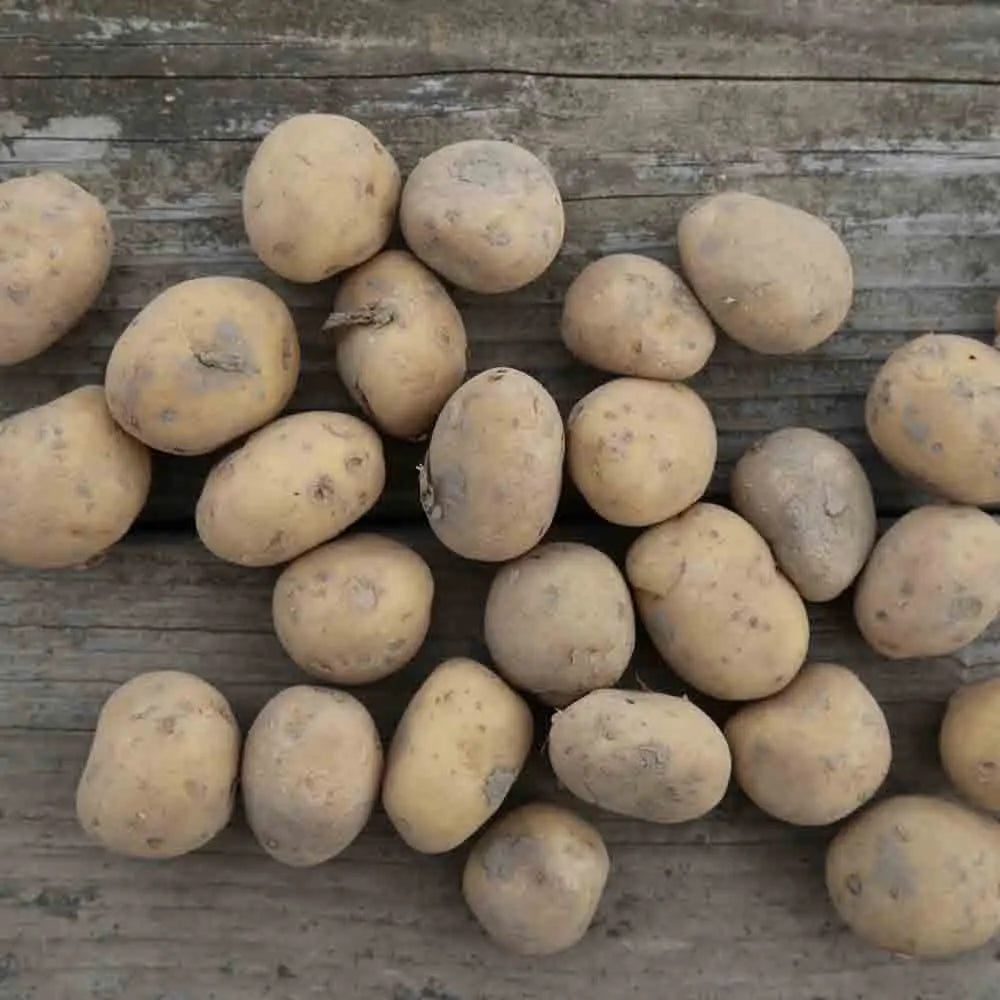
The Vitabella potato is an early variety with firm, yellow flesh known for its resistance to mildew. This potato variety is therefore ideal for wet or mildew-prone soils.
This potato remains firm when cooked, ideal for salads, boiling or sautéing.
Of very good culinary quality and excellent cultivation, this variety will find its place in the garden.
Storing potatoes before planting
Unsprouted tubers should be stored on a shelf in a dry, well-ventilated area. They should be left to germinate for 4 to 5 weeks between 5 and 7°C. Be careful not to allow excessive temperature variations. Plants should not be kept in the dark; on the contrary, it is best to germinate them in a well-lit area to obtain short, stocky sprouts.
If storage is to be longer, it is advisable to place them in a dry place at a low temperature (2 to 4°C, frost-free) to maintain the dormant state.
Prepare the soil before planting
You can incorporate manure or organic fertilizer before planting your potatoes.
Sprouting potatoes
Unsprouted tubers should be stored on a shelf in a dry, well-ventilated area. They should be left to germinate for 4 to 5 weeks between 5 and 7°C. Be careful not to allow excessive temperature variations. Plants should not be kept in the dark; on the contrary, it is best to germinate them in a well-lit area to obtain short, stocky sprouts.
Culture Council
Plant in April/May at a depth of 15 cm, spaced 40/50 cm apart in the row, in rows 60/70 cm apart. Exposure: sunny. Soil: deep, fertile and well-loosened.
Earthing up is essential as the stems emerge, to maintain the plants, encourage the development of the tubers and prevent them from turning green. Start earthing up the plants as soon as they reach 25 cm. This involves burying the bottom of the stems by bringing the soil back towards the plant using a hoe. Repeat this operation during the first month of the plant's development. Hoe occasionally between the plants to aerate the soil and eliminate weeds.
Potato harvest
Harvest after approximately 90 days of cultivation from July to September. Wait until the leaves have wilted and harvest the tubers with a digging fork.
Est-ce que la pomme de terre est un légume ou un féculent ?
Les deux ! D’un point de vue botanique, la pomme de terre est considérée comme un légume étant donné qu’il s’agit d’un tubercule. D’un point de vue nutritionnel, elle est considérée comme un féculent en raison de sa forte teneur en amidon. Dans un repas, elle tend plus à remplacer les féculents que les légumes.
Est-ce que les pommes de terre sont bonnes pour l’intestin ?
Oui, les pommes de terre peuvent être bonnes pour l’intestin, surtout cuites puis refroidies, car elles contiennent de l’amidon résistant qui nourrit le microbiote. Elles sont en général faciles à digérer et faible en FODMAP* si elles sont bien cuites. À éviter surtout : les frites, les portions trop grandes et les préparations très grasses.
*Fermentescibles Oligosaccharides Disacchararides Monosaccharides And Polyols. Ce sont des sucres naturellement peu digérés qui fermentent au contact des bactéries du côlon.
Quelles sont les différentes catégories de pommes de terre ?
On classe les pommes de terre surtout selon leur texture à la cuisson :
- Pommes de terre à chair ferme idéales pour : salades, vapeur, raclettes (Charlotte, Amandine, Ratte).
- Pommes de terre à chair fondante et légèrement farineuse idéales pour : gratin, purée grossière, poêlées (Monalisa, Agata).
- Pommes de terre à chair farineuse riches en amidon idéales pour : purées lisses, frites, potages (Bintje, Aliénor, Cephora).
- Pommes de terre primeurs à peau fine, très digestes et à cuisson rapide idéales à la vapeur ou sautées (Dolwen de Bretagne, Dolwen Primeur, Penni).