
CALVILLE RED WINTER APPLE TREE AB
Malus domestica
 Récolte
Conseils de culture
Description
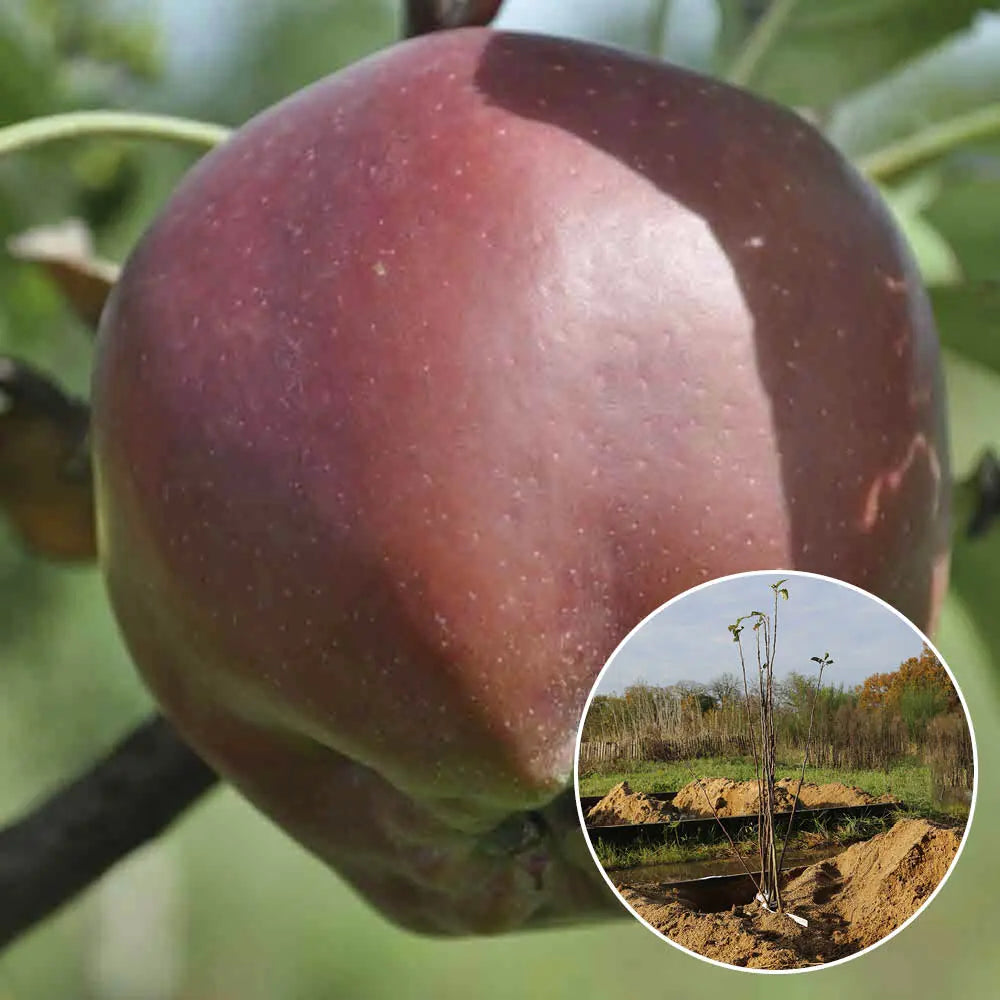
The Calville Red Winter apple tree is an old French variety of Breton origin that was cultivated as early as the early 17th century. It is highly fertile. The apples are fairly late-ripening and can be eaten from late autumn.
Strong vigor. The Calville Red Winter apple tree is a variety well-adapted to mountain areas (up to 1000 or even 1200 m above sea level).
Irregular in shape, the apple is ribbed. The flesh is white and melting, with very little acidity and a strong aroma.
Late flowering (April) for harvest in October. Maturity from November-December
Bare-root fruit trees are planted from mid-October to the end of April, with a preference for autumn and early winter.
Make sure to plant them as soon as you receive them to ensure they take root or place them in a sand gauge for a few days in case of frost.
Prepare planting holes in advance, do not plant fruit trees during frost and above all do not forget to water them.
1. After digging a deep enough hole, remove any broken or overly long roots using pruning shears. A drainage layer at the bottom of the hole (pebbles, pots or broken tiles, etc.) will allow rainwater and watering to flow better.
2. Check that the volume of the branches is balanced with that of the root system; otherwise, reduce the branches. Then coat the roots with praline (this will facilitate contact with the soil, promote the root system and therefore allow for better recovery).
3. When placing the tree at the bottom of the hole, make sure that the graft point is above the hole (if it exists, it is located between the roots and the beginning of the branches, a slightly swollen part), x
4. Cover with soil and water thoroughly.
5. Put up a stake so it can grow properly.
6. Do not leave grass around the tree with a minimum diameter of 1 m. Mulch.
Water regularly in the first few years, especially during hot periods.
In your package, you will find a one-year-old bare-rooted scion. Its size varies from 40 cm to 1.40 m, depending on the growing and climatic conditions of the rootstock and the scion.
A scion has the advantage of being able to be trained in free-running or trained against a support.
To ensure they are shipped in good condition, large trees may be pruned. This is done with a clean cut, not a bud. This does not affect their regrowth or compromise their ability to recover.
The cut tips are suitable for all forms of training, except that of "high stem"
Un scion fruitier produit-il rapidement ?
Un scion, qui est un jeune arbre d'un an, nécessite une période de formation. La production commence en général à partir de la troisième ou quatrième année.
Faut-il le protéger du gel ou des rongeurs ?
- Gel : Les jeunes arbres sont robustes en hiver. Protégez uniquement les fleurs des pommiers adultes en cas de gelées tardives sévères.
- Rongeurs : L'installation d'une gaine ou d'un grillage autour du tronc du scion de pommier est essentielle les premières années pour le protéger des lapins et des rongeurs qui peuvent ronger l'écorce.
Doit-on tuteurer un scion ?
Oui, le tuteurage est indispensable pour assurer l'ancrage du jeune pommier, surtout s'il est exposé au vent. Un simple tuteur planté à côté du tronc (à l'opposé du vent dominant si possible) et attaché sans serrer est suffisant pour les premières années.